Guide
Agentic Systems: What They Are, How They Work and How to Get One Into Production
Every agentic AI story starts the same way. Someone builds a demo. In the room, it lands: the agent reads the request, pulls the data, drafts the reply and files the ticket, and the room leans in. Then the quarter turns, and the demo is still a demo. Either it never reached a real workflow, or it did and quietly broke the first time the input looked nothing like the slide.
This is the shape of the moment we are in. Gartner predicts that over 40% of agentic AI projects will be canceled by the end of 2027, citing escalating costs, unclear business value and inadequate risk controls. The same analysis names the reason the market feels louder than the results: agent washing, the rebranding of assistants, chatbots and old automation as agents. Gartner estimates that of the thousands of vendors selling agentic AI, only about 130 are the real thing.
Here is the argument of this guide. The shift that matters is not from last year's model to this year's model. It is from AI tools and lone agents to agentic systems: coordinated networks of AI agents, workflows, data and human oversight that execute a business process end to end. And the thing that decides whether one delivers is not model capability. It is systems design. The projects that get canceled rarely fail because the agent was not smart enough. They fail because there was no system around it: no coordination, no path to production, no clean data, no owner, no way to tell if it worked.
That distinction is worth getting right, because almost everything about how you scope, staff and measure the work follows from it. This guide covers what an agentic system actually is (and is not), how it differs from AI tools and single agents, what one is made of and how it runs in production, how to choose between buying, boosting and building, and how to get a first system live without becoming a cancellation statistic.
Before you start
What You Will Learn
- What an agentic system is, in one sentence, plus the ladder from assistant to agent to system
- How agentic systems differ from AI agents and AI tools, and why the difference is not size but coordination
- The four parts every agentic system needs, and how they run together in production
- How to choose your path (buy, boost or build) and ship a first system in weeks, not quarters
Overview
AI Tool, AI Agent, Agentic System: The Difference at a Glance
Most of the confusion in this market comes from using one word for three different things. A useful way to keep them apart is to ask who decides what happens next.
| AI tool or assistant | AI agent | Agentic system | |
|---|---|---|---|
| What it does | Answers or drafts on request | Plans and completes a defined task | Coordinates agents, data and workflow to run a process |
| Who decides the next step | You do, every step | The agent, within one task | The system across the workflow, with a human on the loop |
| Scope | A single output | One goal, start to finish | One business process, end to end |
| Where value comes from | A faster draft | A task off your plate | An outcome that compounds |
| Typical failure mode | A confident wrong answer | Right task in the wrong context, or stalls on multi-step work | Missing coordination, data or oversight, so it was never a system |
| Everyday example | A chat assistant summarizing a document | A coding agent fixing one bug | A support operation that triages, resolves, escalates and learns |
Read down the last column and you can see why the category is hard. An agentic system is not a bigger agent. It is a different kind of thing: closer to an operating process than to a clever chatbot.
01
What is an Agentic System?
An agentic system is a coordinated network of AI agents, workflows, data and human oversight that executes a business process, augments a team and improves an outcome. It is not a standalone tool, and it is not a single agent with a longer prompt.
The clearest way to feel the difference is the ladder. An assistant waits for you and answers: you hold the goal, you decide every step. An agent takes a goal and completes a task on its own: it plans, calls tools and returns a result, but its world ends at the edge of that task. An agentic system holds the process: it coordinates several agents and tools across a workflow, draws on the organization's data, writes results back, and runs under a human who sets the boundary and steps in when judgment is required.
That last rung is where most "multi-agent" marketing gets it wrong. Wiring five chatbots together is not an agentic system. What makes it a system is the coordination: a defined workflow, shared context, clear handoffs and someone accountable for the result. Agentic AI and an agentic system are not quite the same phrase, either. Agentic AI is the capability (software that can perceive, reason and act toward a goal). An agentic system is what you build around that capability so it can do useful, repeatable work inside your business. The capability is necessary. The system is what makes it valuable.
Agentic systems vs AI agents
If you take one distinction from this guide, take this one. A single agent is a worker. An agentic system is the organization around the worker: the role definitions, the process, the data it can reach, and the oversight that keeps it aligned.
This is why capable teams keep hitting a ceiling with single agents. A lone agent handles a bounded task well and then degrades the moment the task requires holding several moving parts in mind at once, because it has no model of the wider process it sits inside. We wrote about this failure pattern in why marketing AI agents keep failing at complex tasks: the agent is reactive and single-step by design, and no amount of prompting turns a reactive worker into a functioning department. The fix is not a smarter agent. It is a system: split the work across agents with clear roles, give them a workflow to move through, ground them in shared data, and put a human on the loop. The agent stops being the product. The system becomes the product.
02
What an Agentic System is Made Of, and How it Works
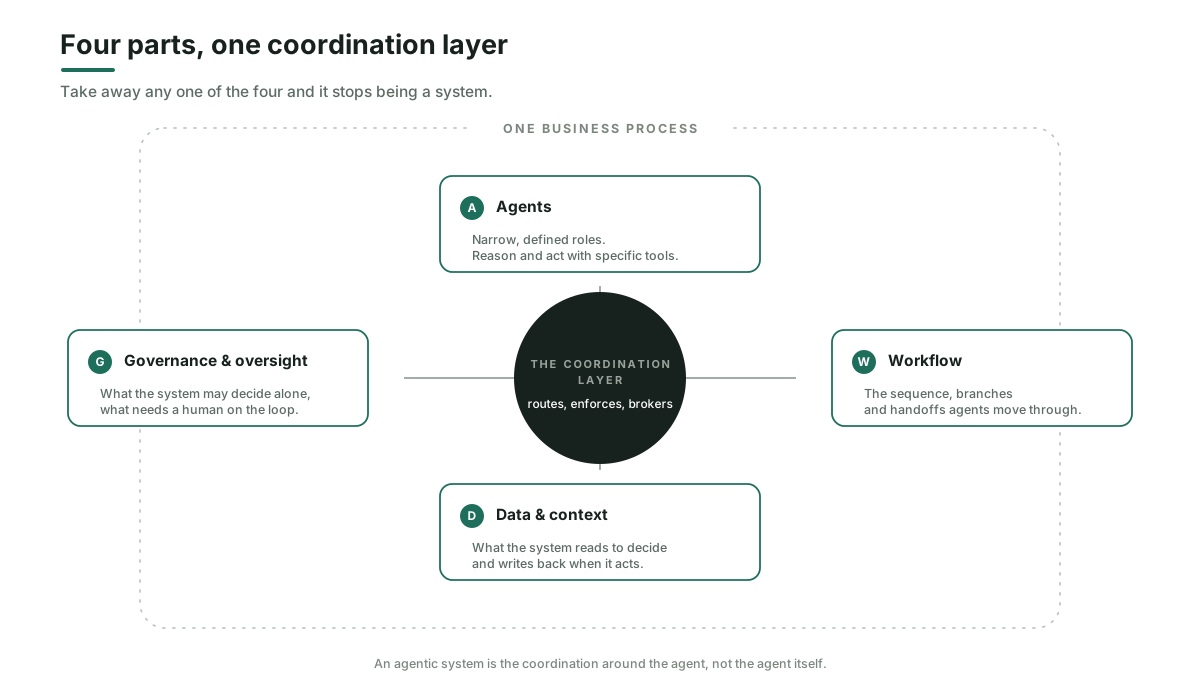
Underneath the label, every working agentic system has the same four parts, held together by a coordination layer.
- Agents do the reasoning and the acting. Each has a defined role and a set of tools it can call, and each is scoped narrowly enough to be reliable. Narrow and coordinated beats broad and brilliant.
- Workflow is the business process the agents move through: the sequence, the branches, the handoffs, the point where the work is done. This is the part teams skip and the part that decides whether anything ships. An agent without a workflow is a party trick. An agent inside a workflow is an operation.
- Data and context are what the system draws on to make good decisions and what it writes back when it acts. This is also the most common point of failure. Agentic systems depend on continuous, clean, structured data to make good calls, and when the feed is fragmented or dirty, the system produces wrong decisions at machine speed. Clean the data before you deploy, not after.
- Governance and human oversight set the boundary: what the system may decide on its own, what needs a human, and how you see what it did. The mature posture here is human-on-the-loop rather than human-in-the-loop, which we explored in the shift from the button to delegated autonomy: the human sets the guardrails and supervises the process rather than approving every keystroke.
A coordination layer orchestrates the four: it routes work between agents, enforces the workflow, brokers access to data, and applies the governance rules. Coordination is the actual product of systems design, and it is the part no model gives you for free.
03
Why Agentic Systems, and Why Now
The direction of travel is not in doubt. Gartner projects that 33% of enterprise software applications will include agentic AI by 2028, up from less than 1% in 2024, and that at least 15% of day-to-day work decisions will be made autonomously through agentic AI by 2028, up from zero in 2024. In the same firm's January 2025 poll of 3,412 organizations, 19% had already made significant investments and another 42% conservative ones. The shift is real, it is fast, and it is funded.
The forces behind it are converging. Foundation models have commoditized, moving the advantage from having the biggest brain to owning the deepest process and data, so the value is now in the system, not the model. Interoperability standards are making coordination across tools practical rather than bespoke. And the cost of pilot purgatory is finally visible on a spreadsheet, which is pushing leaders to ask harder questions about value.
That last point is the catch. Adoption is not the same as return. As we argued in why AI adoption does not equal ROI, the majority of organizations now use AI while only a minority can point to measurable impact. So "now" cuts both ways. The same window that rewards the teams building real systems is the one that produces the 40% cancellation rate for the teams chasing tools. Being early is not the edge. Being early and building a system is.
04
How Organizations Get One: Buy, Boost or Build
Once you see an agentic system as coordination rather than a clever model, the practical question is how to acquire that coordination. There are three paths, a framing that MIT's Center for Information Systems Research set out for generative AI and that we use with clients in our buy, boost or build guide. The paths are not a ladder. They are a decision, and honesty about your position matters more than ambition.
Buy
Buying fits when the process is common and well understood, and speed matters more than differentiation: a standard support triage, a scheduling flow, a document-processing step.
Illustrative
A mid-market software company buys a vendor system for tier-one support: it reads the ticket, matches it against known issues, resolves the routine ones and escalates the rest to a human with a summary, live in a few weeks.
Where it gets tricky: agent washing and shallow value. Much of what is sold as agentic is dressed-up automation, and a bought system rarely reaches the parts of your process that are actually yours. What good looks like: a bounded, measured win on a process you were never going to differentiate on, freeing your effort for the ones you will.
Boost
Boosting is taking a capable vendor foundation and enhancing it with your proprietary data and process knowledge. This is where most successful implementations land, because it puts your edge (your data, your workflow) on top of infrastructure you do not have to build.
Illustrative
A commercial lender boosts a vendor underwriting assistant with its own credit policy and history of past decisions, so the system drafts a risk memo grounded in how the firm actually lends rather than in generic guidance.
Where it gets tricky: data governance, which stops being optional and becomes existential, and operating cost, which rises with customization. What good looks like: a data-first start, usually retrieval before fine-tuning, with the lift measured against the process it improves.
Build
Building is taking full responsibility for the system, and it is the right call only when the process is a genuine source of differentiation and you have the data, talent and appetite to own it.
Illustrative
A logistics operator whose edge is a proprietary routing process no vendor can replicate builds a system around it: agents that reconcile carrier data, reroute the exceptions and hold any shipment for human sign-off when the value at risk crosses a threshold.
Where it gets tricky: cost and talent, and the discipline of proving a clear path from the investment to revenue before committing. What good looks like: a defensible advantage you own outright, not a science project. Most teams overestimate their ability to build and underestimate how far boosting would take them, so start there unless the case for building is unmistakable.
05
Why Agent Projects Stall: Point Tools, Not Systems
If over 40% of agentic AI projects will be canceled, it is worth being precise about how they die, because the cause is almost never the model. It is the absence of a system.
- No coordination. A pile of agents and tools that do not share a workflow or hand off cleanly is not a system, and it breaks the moment the process gets real. We call this the coordination gap: the value is in connecting the dots, and unconnected dots produce nothing.
- No path to production. A demo runs once, in ideal conditions. Production runs a thousand times against messy inputs, and the leap between the two is where projects stall, usually because no one designed for it.
- No data plumbing. Agents act on the data they are given, at speed. Feed them fragmented or dirty data and they make confident wrong decisions faster than a human could catch them.
- No owner. Agentic work falls in the gap between data science, engineering and the line of business, so accountability diffuses and no one is on the hook for the outcome. Systems with no owner do not get fixed when they drift.
- No measurement. If you cannot state the cost per completed task, the intervention rate and the value delivered, you cannot tell a working system from an expensive one, and the budget conversation ends badly.
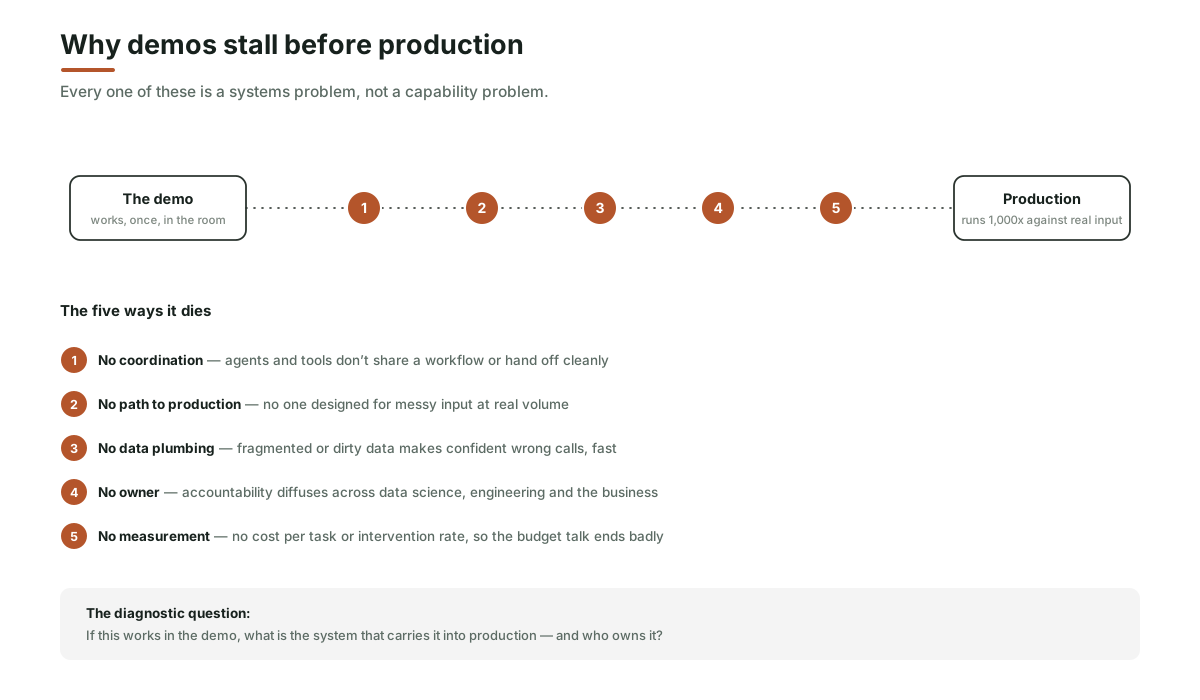
Notice that every one of these is a systems problem, not a capability problem. The diagnostic question to ask before you approve any agentic budget is simple: if this works in the demo, what is the system that carries it into production, and who owns it? If you cannot answer, you are funding a demo.
06
How to Get Started Without Becoming a Statistic
The way through is not more ambition. It is a smaller, better-built first system.
Start where the work actually happens. Map one high-value business process before writing any code, and find the step where a coordinated system would change the outcome. Successful projects begin with a clear picture of how work gets done, not with a model.
Then scope the smallest useful system: one workflow, a couple of agents with clear roles, the data they need and a human on the loop. Instrument it for value from day one so you can prove the return rather than assert it. Choose your path honestly using buy, boost or build, and default to boosting unless the case for building is unmistakable. Then get it into production in weeks rather than quarters, which is the discipline behind our five drivers for moving pilots into production.
A few practical questions
- Budget: the cost that matters is not the pilot, it is production and the operating cost of a system running against real volume, so scope to a first win you can measure, not a moonshot.
- Data: clean and structure the data the system will touch before you deploy, because dirty data does not slow an agentic system down, it makes it wrong at speed.
- Timeline: a first production loop is a matter of weeks when the process is well chosen, and a matter of never when it is not.
- Team: this is systems and process work, so you need process owners, data and governance around the table, not only prompt engineers.
- Build vs. buy reflex: most teams overestimate building and underestimate boosting, so start with the path that gets a real system live soonest.
Which brings us back to the demo that never shipped. The difference between that demo and a system that compounds was never the agent. It was the coordination, the workflow, the clean data and the human on the loop: the system around the agent. Build the system, and the agent finally gets to do the work it looked so good at in the room.
See What System Your Process Needs
Most teams cannot name the first loop to close, because they cannot see where coordination fails. That is the fastest thing to diagnose.