Guide
Agentic Workflows: What They Are, How They Differ From RPA and How to Build Them
Every operations leader has a bot graveyard. Somewhere in the estate sits a fleet of RPA scripts that worked beautifully in the demo and now break every time a vendor moves a form field, a portal adds a login step, or an invoice arrives in a format nobody anticipated. Each break lands in a queue, a human picks it up, and the automation that was supposed to remove the work quietly generates a new job: babysitting the automation.
Agentic workflows are the response to that pattern, and the promise is genuinely different from a better script. An agentic workflow does not follow a fixed path. It pursues a goal, reasons about how to reach it, uses whatever tools the situation requires, handles the exception instead of escalating it, and checks its own work against guardrails you set. Where RPA automates the steps you could already write down, agentic workflows take on the exception-heavy, judgment-laden work that never fit a flowchart in the first place.
Here is the thesis, and it is the part most coverage misses. The value of agentic workflows is not that they do the same tasks faster. It is that they reach across the system boundaries where work used to stall because coordination was too expensive to happen, the seams between departments, tools and datasets that no single RPA bot could ever span. Treat an agentic workflow as a faster bot and you will rebuild the bot graveyard with a larger budget. Treat it as a way to close coordination gaps and the return looks entirely different.
This guide covers what an agentic workflow actually is, how it differs from RPA, IPA and BPA, where it wins and where it does not, why the projects stall and how to build one that holds up in production.
Before you start
What You Will Learn
- What an agentic workflow is, in one extractable definition, and how it differs from agentic AI in general
- How agentic workflows differ from RPA, IPA and BPA, and where each still wins
- The three kinds of work where agentic workflows pay off, and where they get tricky
- Why agentic workflow projects stall, and how to build one that reaches production
01
What is an Agentic Workflow?
An agentic workflow is a business process executed by one or more AI agents that pursue a defined goal by reasoning about context, choosing and using tools, and adapting to exceptions without a human approving each step. The load-bearing words are goal and adapt. A traditional automation is told exactly what to do; an agentic workflow is told what outcome to achieve and given the latitude, and the guardrails, to work out the how.
That answers the adjacent question people often ask first, which is what agentic AI is. Agentic AI is the broader capability, software that can plan and act toward goals rather than only respond to prompts. An agentic workflow is that capability pointed at a specific business process, with the tools, data and oversight wired in. Agentic AI is the engine; the agentic workflow is the thing it drives.
The cleanest way to place the term is to ask who decides what happens next. In a scripted automation, the author decided, in advance, for every case. In an assisted workflow, a human still decides at each turn using AI input. In an agentic workflow, the system decides within a boundary you set, and escalates to a human only when it hits the edge of that boundary. That single question, who decides the next step, separates agentic workflows from almost everything they get confused with.
02
Agentic Workflows vs RPA, IPA and BPA
The comparison that matters most is against robotic process automation, because that is the mental model most buyers arrive with, and it is the wrong one. The short version: RPA follows rules, agentic workflows pursue goals.
| RPA | IPA | Agentic workflow | |
|---|---|---|---|
| Core logic | Fixed rules, recorded steps | Rules plus AI for specific decisions | Reasoning toward a goal |
| Handles exceptions? | No, it escalates | Some, with human in the loop | Yes, within guardrails |
| When the interface changes | Breaks | Often breaks | Adapts |
| Human role | Fixes breaks | Decides at each step | Sets goals and guardrails, on the loop |
| Best for | Stable, high-volume, deterministic tasks | Structured tasks needing light judgment | Exception-heavy, cross-system work |
Robotic process automation assumes a stable interface and a predictable path. It is genuinely excellent when both hold, a compliance report that runs the same way every month, a data transfer between two systems that never change. Intelligent process automation, IPA, adds AI to inform specific decisions, document extraction or routing, but a human still closes the loop between insight and action. Agentic workflows embed the decision itself, which is what lets them handle the exceptions that RPA can only escalate. Business process automation, BPA, sits at the orchestration layer above all of this, coordinating the end-to-end flow.
The practical answer to how agentic workflows differ from RPA or IPA is therefore not that one replaces the other. Most enterprises will run them together: RPA for the deterministic, compliance-heavy core, agentic workflows for the exception-heavy work RPA could never scale to, and BPA orchestrating the whole. The mistake is category confusion, buying an agentic workflow to do a job RPA already does cheaply, or expecting an RPA bot to handle the ambiguity only an agent can.
03
How an Agentic Workflow Works
Under the hood, an agentic workflow runs a loop, and understanding the loop is what separates teams that build reliable ones from teams that build impressive demos. Four moves repeat: the agent perceives the current state, plans the next action toward its goal, acts by calling a tool or another agent, and verifies the result before deciding whether to continue, retry or escalate. The loop runs inside a boundary of guardrails, and a human sits on the loop rather than in it.
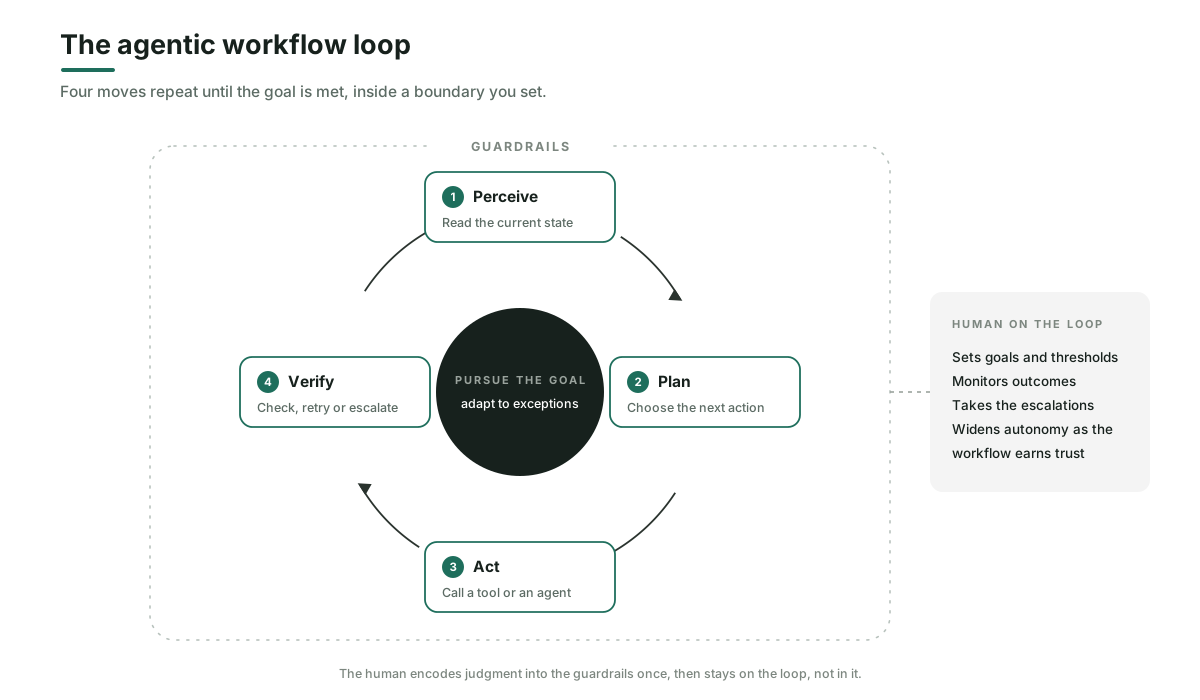
That last point is the whole governance model, and it is covered in depth in After the Button and in 2026 is the Year of Autonomous Marketing. Human-in-the-loop means approving every action, which makes you the bottleneck the moment volume rises. Human-on-the-loop means encoding your judgment into the guardrails and thresholds once, then monitoring outcomes and intervening at the edges. When metrics stay in band, the workflow runs. When they drift, you investigate. That is how an agentic workflow scales without a human rubber-stamping outputs nobody actually evaluated.
When a process is genuinely complex, one agent is rarely enough, which is where multi-agent systems for business come in. Instead of a single agent doing everything, specialized agents handle different steps, a research agent, a drafting agent, a checking agent, coordinated by an orchestrator. That buys capability but introduces real cost: agents have to share memory, hand off cleanly and recover when one of them fails. The six agentic design patterns product and business leaders need to understand are the vocabulary for making those choices deliberately rather than discovering the failure modes in production.
04
Where Agentic Workflows Pay Off, and Where They Get Tricky
Not every process is a candidate, and matching the workflow type to the work is the difference between a return and a rebuilt bot graveyard. Three categories cover most of it.
Deterministic, high-volume work
Stable inputs, a fixed path, little judgment. Here RPA usually still wins, and an agentic workflow is over-engineering. The tell is that you could write the full rulebook in an afternoon and it would rarely change. Where it gets tricky is the temptation to “upgrade” these to agents for their own sake, adding cost and unpredictability to work that was already solved.
Exception-heavy, judgment-laden work
This is the agentic sweet spot. Invoice processing where a fifth of documents arrive in some unexpected shape, support cases that do not match a template, claims that need a judgment call. Consider a finance team whose reconciliation process ran smoothly for the 80% of transactions that matched cleanly and drowned on the 20% that did not; an agentic workflow that reasons through the messy fifth is where the hours actually were. The mechanism is the lesson there, not any specific percentage. Where it gets tricky: if you cannot articulate what a good judgment looks like, the agent cannot either, and you will get confident wrong answers instead of escalations.
Cross-system, coordination-heavy work
The largest prize and the least obvious. Work that spans several tools, teams and datasets, order-to-cash across CRM, ERP and support, onboarding that touches HR, IT and facilities. This is the white space Agentic Foundry keeps returning to in Bridging Coordination Gaps and Unlocking Hidden Value: System Boundaries Are Where the Money Is. The value is not automating any one step; it is closing the gap between systems that were never designed to talk. Where it gets tricky: these workflows expose every integration weakness and data-quality problem you have been living with, so they demand the most groundwork.
05
Why Agentic Workflows Now
The timing is not hype, it is a measurable shift in what organizations are actually running. McKinsey's State of AI, late 2025, found roughly 23% of organizations already scaling an agentic AI system somewhere in the enterprise, with another 39% experimenting. Gartner projects that 33% of enterprise software applications will include agentic AI by 2028, up from less than 1% in 2024, and that at least 15% of day-to-day work decisions will be made autonomously by then. Both Forrester and Gartner point to multi-agent deployment as the near-term frontier, because single-purpose agents have already hit their ceiling for real enterprise processes.
Several forces converged to make this the moment. Models became capable enough to plan and use tools reliably, not just generate text. Tool-calling and orchestration frameworks matured, so wiring an agent into real systems stopped being a research project. And the cost of inference kept falling, which turned workflows that were economically absurd a year ago into ones that pencil out. The convergence is why the bot graveyard suddenly has an alternative that did not exist when those bots were written.
06
Why Agentic Workflow Projects Stall
Now the honest part, because the same Gartner analysis carries a warning: over 40% of agentic AI projects will be canceled by the end of 2027, driven by escalating costs, unclear business value and inadequate risk controls.
The failure is rarely the model. It is structural, and it lives at the joints of the loop.
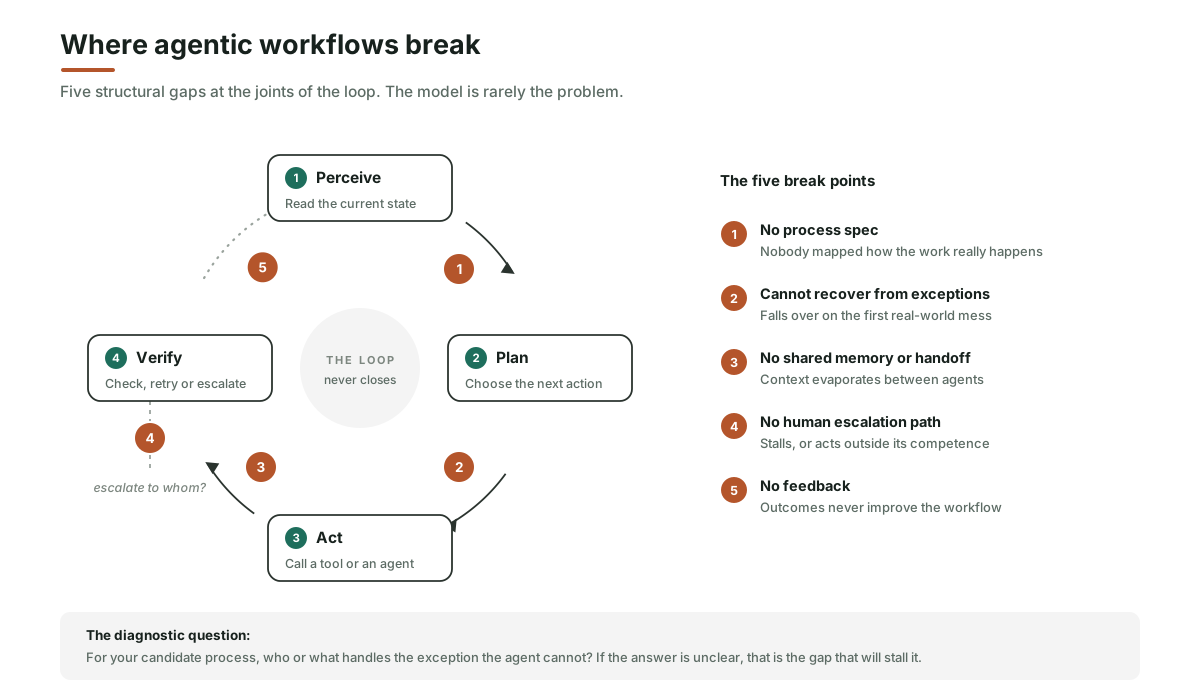
- No process spec. Teams point an agent at a process nobody has actually mapped. If you cannot describe how the work really happens, including the exceptions, the agent inherits your ambiguity and improvises. This is exactly what Intelligence Mapping exists to prevent, by revealing where value lives before any code is written.
- Cannot recover from exceptions. The workflow handles the happy path and falls over on the first real-world mess, which is the one thing it was supposed to be better at than RPA. Exception handling is not a feature you add later; it is the reason to build the thing.
- No shared memory or clean handoff. In multi-agent workflows, context evaporates between agents. The drafting agent does not know what the research agent found, so quality collapses at the seams, the same seams the workflow was meant to close.
- No human escalation path. Autonomy without a clear off-ramp is a liability. When the agent hits the edge of its guardrails and there is no defined way to hand off to a person, it either stalls or, worse, acts confidently outside its competence.
- No feedback. The workflow runs but never learns, because outcomes are not fed back to improve it. Without that return arrow, you have automation, not an agentic system, and the loop that should have compounded value just repeats.
One diagnostic question to ask before you build: can you name, for your candidate process, who or what handles the exception the agent cannot? If the answer is unclear, you have found the gap that will stall the project.
07
How to Build an Agentic Workflow That Reaches Production
The practical turn is smaller and less glamorous than the pitch, and that is the point. Start by picking one exception-heavy process where the judgment is real but describable, not the flashiest candidate and not a deterministic task RPA already handles cheaply. Map how the work actually happens, exceptions included, before writing anything; this is the step teams skip and the reason most stall.
Then build the loop deliberately. Define the goal and the guardrails, wire the tools the agent needs, design the exception and escalation paths as first-class features rather than afterthoughts, and instrument outcomes so the workflow can be evaluated and improved. Decide honestly whether you need one agent or several, and if several, treat memory and handoff as the hard part, because they are. On the build-versus-buy question, the same discipline from Three Paths to AI Implementation applies: buy the commodity, build only what is genuinely yours.
Run it human-on-the-loop from the start. Set the thresholds that trigger a human, monitor the outcomes, and widen the agent's autonomy as it earns trust rather than granting it all on day one. FORGE, Agentic Foundry's five-phase implementation method, exists precisely to carry a workflow from this kind of scoped pilot into production without falling into the 40% that get canceled. The teams that ship are not the ones with the best models. They are the ones who mapped the process, built the exception paths and closed the feedback loop.
The Graveyard Was Never a Technology Problem
Return to the bot graveyard. Those scripts did not fail because automation was a bad idea. They failed because they could only follow a path, and real work does not stay on the path. Agentic workflows are the first automation that can leave the path and still reach the goal, which is why they can finally take on the exception-heavy, cross-system work that has been stranded in human queues for years.
The organizations that will pull ahead are not the ones that deploy the most agents. They are the ones that map the work honestly, build the loop with its exception paths and feedback intact, and keep a human on the loop where judgment belongs. The path-following era of automation is ending. What replaces it is not a faster bot. It is a workflow that adapts.
Map the Work Before You Automate It
The fastest way to a stalled agentic workflow is to point an agent at a process nobody has mapped. The fastest way to a return is to do the mapping first. Talk to us about mapping your highest-value process and building the agentic workflow that closes the gap RPA never could.