Guide
AI ROI: How to Measure Return, Build the Business Case and Prioritize Your Investments
Your AI pilot demos beautifully. The productivity numbers in the deck are compelling. Adoption climbs, the tool gets rave reviews in the all-hands, and everyone agrees it is working. Then the quarterly review arrives, someone from finance asks what moved in the P&L, and the room goes quiet.
That silence is the AI ROI problem in one scene, and it is nearly universal. A 2025 MIT study of enterprise generative AI found that 95% of deployments showed no measurable impact on profit and loss, despite an estimated $30 to $40 billion in enterprise investment. McKinsey's State of AI, published in late 2025, found the mirror image from the top down: about 39% of organizations report any measurable earnings impact from AI, and only 6% clear a 5% or greater share of earnings attributable to it.
Here is the thesis, and it is not that the technology underdelivers. AI ROI stays invisible because most organizations measure adoption and call it return. They track logins, seats and time saved, then assume value followed. It usually did not, because value only shows up when a saved hour is converted into fewer people doing the work, more work done by the same people, a faster decision that changes an outcome, or a capability the business did not have before. That conversion is a design choice, not an automatic consequence of usage.
This guide covers how to measure AI ROI across the dimensions where value actually accrues, how to build an AI business case that survives a finance review, and how to prioritize a portfolio of AI investments so the returns compound instead of stalling.
Before you start
What You Will Learn
- Why adoption is not ROI, and the four dimensions where AI value actually shows up
- A framework for measuring AI ROI that a CFO will accept, including the counterfactual and the second-cycle costs most cases ignore
- How to build a fundable AI business case, from quantifying impact to framing risk
- How to prioritize AI investments as a portfolio, using a scoring instrument that balances value against deliverability
01
What is AI ROI, and What is ROAI?
AI ROI is the net business value an AI investment produces relative to its full cost, measured across the dimensions where AI actually creates value rather than by usage or output volume alone. That last clause is the whole game. Classic ROI assumes one input, one output and a clean payback line. AI breaks that assumption because a single deployment can cut cost in one place, add capacity in another, speed a decision in a third and build reusable capability in a fourth, and only some of that lands directly in the P&L.
That is why Agentic Foundry uses a broader lens we call ROAI, Return on AI, and it is the subject of a fuller treatment in Why AI Adoption Doesn't Equal ROI. The shift ROAI forces is from a use-case mindset to a portfolio mindset, and from a single-metric calculation to a multidimensional view of value. The question stops being “did people use it” and becomes “what value did the use create, and did we capture it.”
ROAI has two parts. It measures value across four dimensions, so no single number can flatter or damn the whole picture. And it prioritizes initiatives by scoring them on Impact and Feasibility, so a portfolio balances the value on offer against the organization's ability to actually deliver it. The rest of this guide covers both parts, four dimensions first, because you cannot prioritize what you cannot measure.
02
The Four Dimensions of AI Value
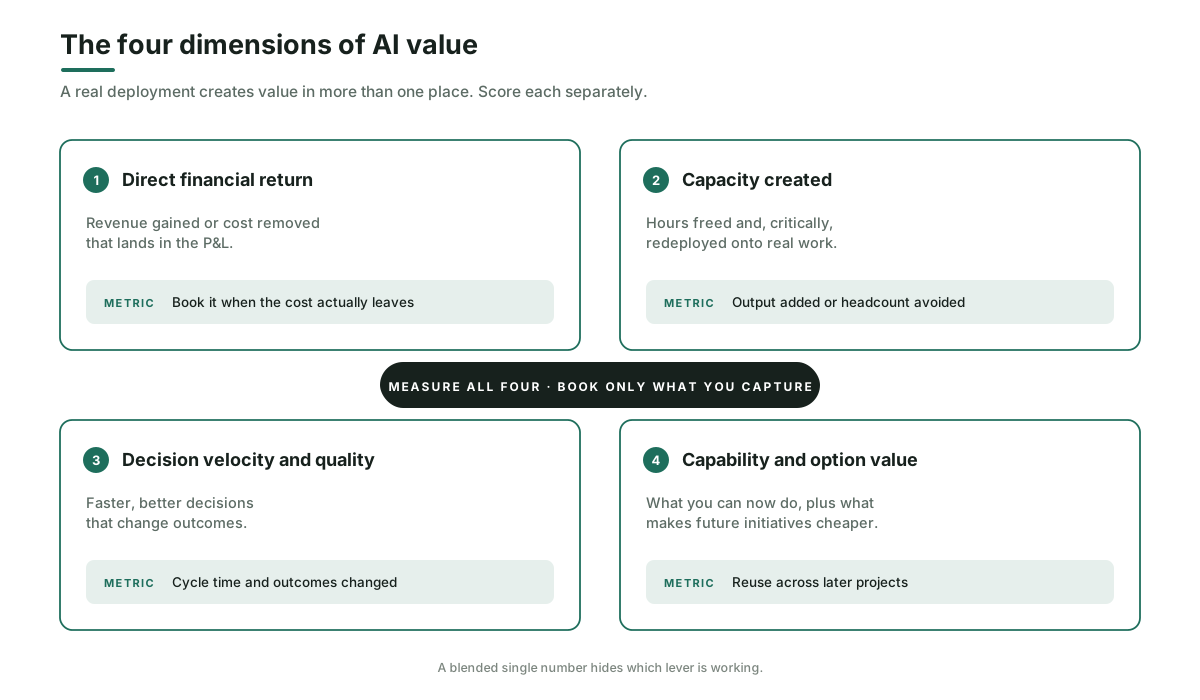
The ROAI framework tracks value across four dimensions. The point of separating them is that a real deployment usually creates value in more than one, and a single blended number hides which lever is actually working.
- Direct financial return. Revenue gained or cost removed that lands in the P&L. This is the dimension finance trusts, and it is the one to lead with when it is real. The discipline is to book it only when the cost actually leaves, when the contractor is not renewed or the process genuinely runs with fewer people, not when a spreadsheet says time was saved.
- Capacity created. Hours freed and, critically, redeployed. Freed capacity is only value if it goes somewhere, so the metric is not hours saved but output added or headcount avoided as the business grows into the slack. Capacity that gets quietly reabsorbed into longer coffee breaks is a cost with no return.
- Decision velocity and quality. Faster, better decisions that change outcomes. A forecast that lands two weeks sooner, a pricing call made daily instead of monthly, a risk flagged before it compounds. Harder to attribute, often the largest prize, and the dimension most likely to be left out of a business case entirely because it resists a clean formula.
- Capability and option value. What the organization can now do that it could not before, plus the data and infrastructure that make future initiatives cheaper. This dimension pays back on a different clock, quarters rather than weeks, and it is the one a naive ROI calculation zeroes out by definition. Killing a capability investment because it misses a payback target it was never designed to hit is how organizations optimize their way out of every return that would have come next.
03
Why AI ROI Stays Invisible: The Value Realization Gap
If the four dimensions are where value lives, the value realization gap is where it leaks out before it reaches the P&L. This is the structural reason 95% of deployments show no measurable financial impact, and it is structural, not a capability problem with the models. Value drains at a series of predictable joints between “we bought AI” and “the business is measurably better off,” and every unplugged leak is return you paid for and never collected.
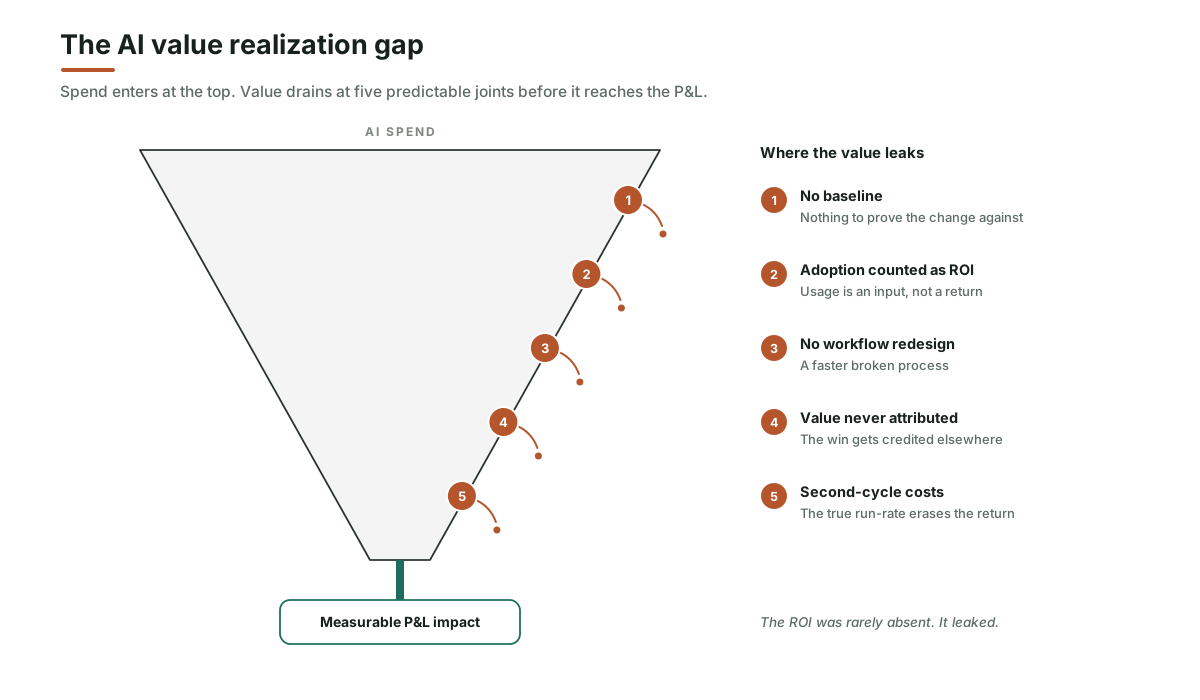
- No baseline. You cannot prove a change you never measured. Teams that skip capturing the before state, cost, cycle time and error rate as they were, have no way to attribute any improvement later, so the value becomes an argument instead of a number.
- Adoption counted as ROI. The most common leak. Seats filled and hours logged get reported as return, but usage is an input. If the freed time is not redeployed and the cost is not removed, adoption is pure spend.
- No workflow redesign. McKinsey's data is blunt here: high performers are far more likely to redesign the underlying workflow when they deploy AI, with about 55% redesigning workflows versus roughly 20% of everyone else. Bolt an agent onto a broken process and you get a faster broken process, not a return.
- Value never attributed. Even real gains stay invisible when nobody connects them back to the initiative. The forecast improved, but the win got credited to the sales team. Without attribution, the next funding round starts from zero.
- Second-cycle costs. Integration, oversight, model spend at scale and change management are real and recurring, and a business case that counted only the pilot cost will show a return that evaporates the moment the true run-rate arrives.
One question to ask yourself before the next AI investment: for the last one, can you name the baseline you measured against and the leak you closed to capture the value? If not, you have found why the ROI is invisible.
04
How to Build an AI Business Case That Gets Funded
A fundable AI business case makes four things legible to leadership at once, impact, return, real cost and risk, and most initiatives stall because one of the four stays vague. This is the practical core of the pillar, and it is treated at length in Building an AI Business Case That Actually Gets Funded. The structure below is the short version.
- Quantify the impact. Name the value in the terms the business already tracks: revenue, cost, risk reduction, new capability, strategic alignment. Tie it to the four dimensions above so you are not silently dropping the capacity, decision and capability value that a P&L-only case leaves on the table.
- Model the return honestly. The single most important input is the counterfactual: what happens if you do nothing, because the return is the difference between the two futures, not the gross number. Then state time to first value, time to steady state, how the impact scales, and a confidence range rather than a false-precision point estimate.
- Account for the real cost. Budget the full life, not the pilot: technology at scale, data readiness, integration and upkeep, oversight and governance, change management, and the second-cycle costs that arrive after launch. A case that hides these wins the funding meeting and loses the renewal.
- Frame the risk. Name the top risk plainly, separate reversible risks (which you handle with scaffolds and monitoring) from irreversible ones (which need hard guardrails), and set the triggers that would make you revisit the decision. Leadership funds honesty about risk faster than it funds its absence.
05
How to Prioritize AI Investments as a Portfolio
Once you can measure value and build a case, prioritization is the next real decision, and the answer is to run a portfolio, not a queue. A queue funds whatever demoed best last week. A portfolio balances near-term efficiency returns against the capacity, decision and capability investments that pay back on longer clocks, so a single slow-paying foundation bet does not get killed for behaving exactly as designed.
The ROAI scoring instrument does the sorting. Every candidate initiative is scored on two axes:
- Impact measures how much value the initiative would create. It operationalizes the four value dimensions above through five scored sub-dimensions: strategic alignment, value potential, user & customer benefit, competitive advantage and scalability.
- Feasibility measures how realistically the organization can actually deliver it. It is scored across five sub-dimensions of its own: technical realism, data readiness, operational realism, time to value, and risk and governance.
A cross-functional panel scores each sub-dimension 1 to 5, independently before any group discussion, so the spread stays visible and outlier assumptions get surfaced instead of averaged into invisibility. The consensus Impact and Feasibility scores then plot the initiative on a 2x2 matrix that produces the working priority.
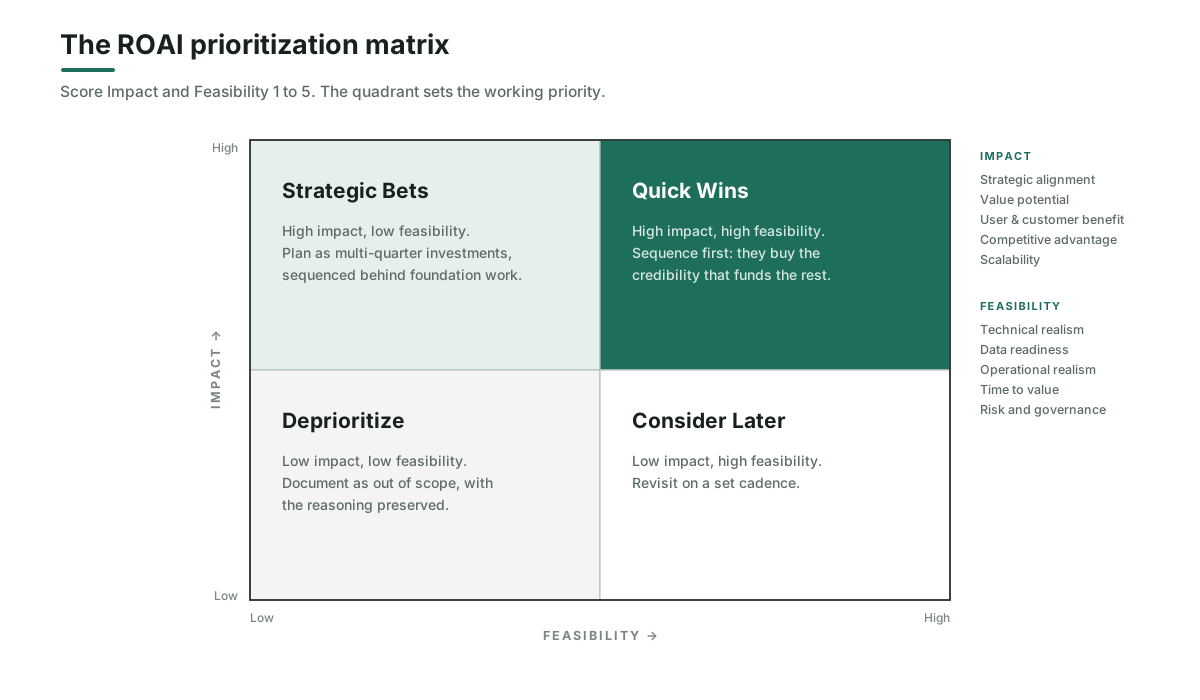
Quick Wins get sequenced first because they buy the credibility that funds everything else. Strategic Bets get planned as multi-quarter investments, sequenced behind the foundation work they depend on rather than launched into a process that cannot yet support them. Consider Later items get revisited on a set cadence. Deprioritize work gets documented as out of scope with the reasoning preserved so the same idea does not resurface next quarter with a new sponsor and no new evidence.
The trap the matrix prevents is the queue trap: a high-impact idea launched into a data stack, a workflow or a team that cannot yet carry it. That is not prioritization; it is expensive learning. Sequence the foundation work in front of the initiatives that need it, not underneath them.
Two adjacent Agentic Foundry frameworks do the surrounding work. Intelligence Mapping reveals where AI can create value before any code is written, by starting from how the work actually happens, which is how you avoid funding a solution to a problem the business does not have. And FORGE, our five-phase implementation method, is built to carry a prioritized initiative from experimentation into production, which is the only place returns are ever actually collected.
The practical first move is smaller than most teams expect. Pick one initiative that scores as a Quick Win, capture the baseline before you touch anything, redesign the workflow rather than bolting the tool onto it, and instrument all four value dimensions from day one. Ship that, attribute the value out loud, and use the credibility it buys to fund the slower-paying plays behind it. That is the opposite of the boil-the-ocean AI transformation, and it is the version that survives contact with a finance review.
The Room Does Not Have to Go Quiet
Return to that quarterly review. The reason the room went silent was not that AI failed to deliver value. It was that nobody had decided, in advance, which of the four dimensions this investment was supposed to move, captured the baseline to prove it, redesigned the work to capture it, and attributed the result when it arrived. AI ROI is not a number you discover after the fact. It is a set of choices you make before you spend, and then defend all the way to the P&L.
The organizations pulling measurable returns are not running better models than everyone else. They are running the same models with the discipline to convert usage into value and the honesty to measure all four dimensions of it. That discipline is learnable, and it is the difference between being in the 95% and being in the 6%.
Find the AI ROI You Are Already Leaving on the Table
The fastest way to improve AI ROI is usually not a new tool. It is closing the value realization leaks on the investments you have already made. Talk to us about mapping where your AI value is leaking and building the business case that captures it.