Guide
Autonomous Marketing: What It Offers and How It Works for B2B, B2C and Regulated Industries
TL;DR
Autonomous marketing uses AI systems to decide and act across the funnel within guardrails you define. It differs from automation because it adapts — not just repeats. It works in B2B, B2C and regulated industries and does not require replacing your stack. Start with one closed loop, prove it, then expand.
Too many marketers are stuck in the movie Groundhog Day. Tweak the bids, refresh the creative, reconcile the reports, brief the next campaign. And like Bill Murray's weatherman, next week they do it all over again.
Learning gets lost in slide decks. Each quarter starts from scratch. Rinse and repeat.
Autonomous marketing breaks the loop. It is AI systems that decide, act and learn from outcomes, so each cycle feeds the next and the learning compounds instead of resetting.
This does not require a stack overhaul. Autonomous marketing is not rip and replace. It is coordinate and connect. The tools you already have can support autonomy if you wire them together correctly.
But most implementations stall. Not because the AI is not capable. Because the loops cannot close across a fragmented stack.
This guide covers three things: what autonomy actually looks like in B2B, B2C and regulated industries, where it breaks down and how successful pilots start by closing one loop before expanding.
Before you start
What You Will Learn
- What autonomous marketing is, and how it differs from automation
- What autonomy looks like in B2B, B2C and regulated environments
- Why most implementations stall on coordination gaps between tools, not on model capability
- How successful pilots start with one loop and expand from there
Overview
B2B vs B2C vs Regulated — At a Glance
| B2B | B2C | Regulated | |
|---|---|---|---|
| Primary metric | Pipeline quality, stage progression, revenue-linked proxies | Contribution margin, payback window, retention | Compliant growth with documented behavior and low variance |
| First loop to pilot | Paid search to demo request, measured by meeting-held rate | Creative iteration in one channel with a profit-aware metric | Rotation among pre-approved creative variants with strict logging |
| Typical guardrails | ICP boundaries, approved claims library, sales-agreed definitions | Budget swing limits, frequency caps, brand playbook | Risk-tiered approvals, claims library, audit-trail requirements |
| Common failure | Optimizing for MQL volume floods sales with low-intent leads | Chasing short-term ROAS erodes brand and margin | Unsubstantiated claims or prohibited targeting triggers compliance risk |
| Feedback speed | Slow. Four to 12 weeks for directional signal, months for revenue outcomes | Fast. Hours to days for conversion signals | Varies. Fast on engagement, slow on compliance review cycles |
01
What is Autonomous Marketing?
Autonomous marketing is the use of AI systems to make decisions and take actions across the marketing funnel, including targeting, budgeting, creative iteration, personalization and sequencing, based on goals and feedback loops.
Humans define the outcomes, set the constraints and govern the boundaries. The system handles execution and optimization within those bounds.
The key word is autonomous. It implies more than assistance and more than rules-based automation. An autonomous marketing system does more than execute a workflow you designed. It can propose, test and optimize the workflow itself, within constraints.
A simple way to understand the difference is to ask one question.
Who decides what happens next?
- In traditional marketing operations, humans decide and tools execute
- In marketing automation, humans predefine rules and flows, then the platform executes those rules
- In autonomous marketing, humans define outcomes and constraints, and the system decides which actions to take to hit those outcomes
In practice, most implementations will not be fully autonomous. A better way to think about it is bounded autonomy. The AI is allowed to act inside clear guardrails and escalates anything risky to a human. This is the posture Stanford's Institute for Human-Centered AI has argued for: design AI to augment human judgment rather than replace it, and treat the biggest gains as the work people and machines do together, not automation alone.
That shifts operators toward human-on-the-loop governance, where you tune, monitor and handle exceptions over time instead of approving every action.
And it does not mean replacing your stack. Most organizations already have the platforms they need: ad tools, customer relationship management (CRM), email, analytics. The gap is rarely capability. It is coordination. Autonomy emerges when those systems can share signals and act on shared outcomes.
02
Marketing Autonomy vs Marketing Automation
Marketing automation is deterministic by design. You define triggers and actions. If a lead downloads a whitepaper, send email sequence A. If they click pricing, notify a sales development rep.
Automation is valuable, but it assumes you already know the correct strategy and sequencing. It also assumes systems can hand off cleanly, which is rarely true when the trigger lives in one platform and the action executes in another.
Autonomy depends on closed loops. If your CRM outcomes cannot inform your ad targeting, or your email engagement cannot feed back into audience decisions, the system is making choices with partial information. You can automate a lot of activity and still fail to improve outcomes, because the loop never closes.
Autonomous marketing treats strategy and execution as something the system can continuously improve. It uses performance data and constraints to decide whether to emphasize a segment this week, whether a creative concept is fatiguing, whether spend should shift from channel A to channel B, or whether a partner source is converting poorly and should be suppressed.
If automation is about repeatability, autonomous marketing is about adaptability. But adaptability requires visibility across systems. That is where most implementations hit friction.
A quick comparison
| Model | Who decides | Best at | Common failure mode |
|---|---|---|---|
| AI assistance | Human | Drafting, analysis and speed | More output without better decisions |
| Marketing automation | Human or rules | Repeatable workflows at scale | Brittle across tools, blind to outcomes |
| Autonomous marketing | System within constraints | Faster learning cycles tied to outcomes | Local optimization when loops do not close |
| Agentic marketing | Agents plan and act across tools | Multi-step execution across systems | Hard to govern without bounded autonomy |
The terms blur in the market, so it is worth being precise. Autonomous marketing is the outcome: a system that decides, acts and learns in a closed loop within guardrails. Agentic marketing is one way to build it, using AI agents that plan and act across tools. Marketing orchestration is the coordination layer that makes either possible. Without orchestration, an autonomous system can only optimize locally, inside individual platforms, and the loop never closes.
03
What Autonomous Marketing Does
Think of autonomous marketing as a closed-loop operating system for growth. It does not just produce assets. It continuously decides what to do next based on what is working.
Instead of relying on periodic human reviews to adjust campaigns, the system runs a steady cadence of hypothesis, action and feedback while operating inside the guardrails you set for brand, budget and risk. The output is not more content. It is better decisions, faster, tied to measurable outcomes.
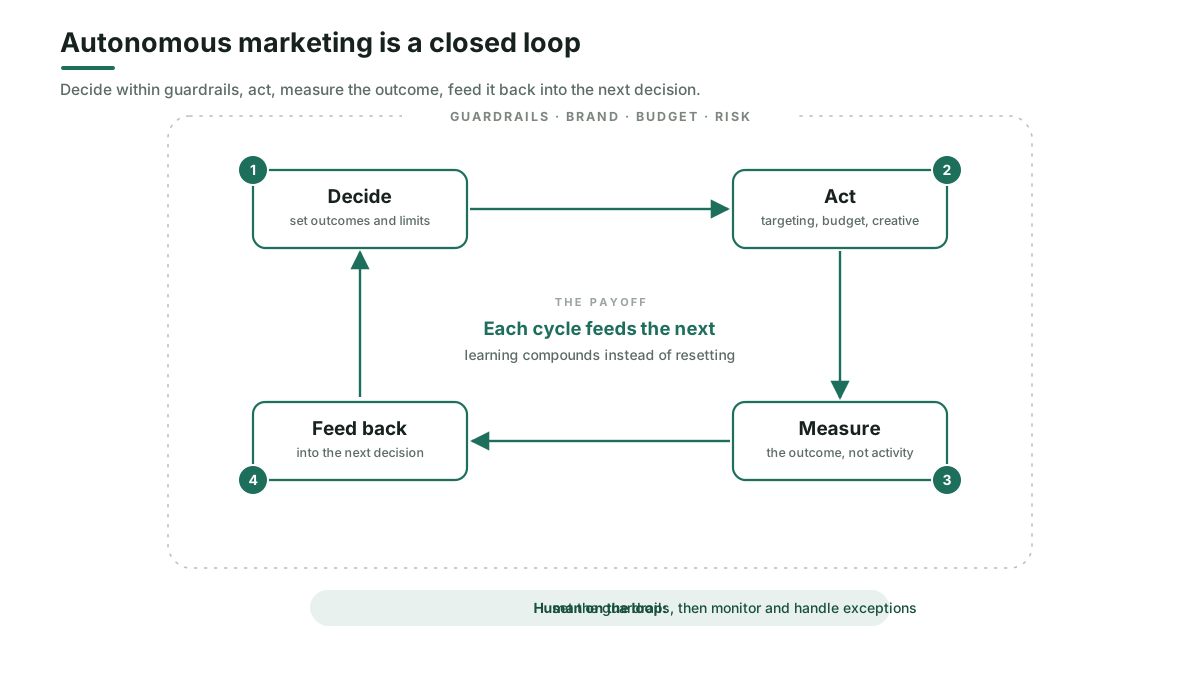
In practice, autonomy might show up as the system generating new ad variants and allocating spend. It also shows up in subtler ways: selecting among pre-approved creative modules, managing frequency caps, or recommending which segment gets which nurture path. This is not the same as personalization. Personalization tailors content to a person; autonomy decides what to test, what to prioritize and when to act. You can have one without the other.
The more important point is that an autonomous marketing system is a decision engine, not just a content engine. And a decision engine needs data from across the stack to make good calls.
04
Metrics and Incentives: Aim at the Right Target
Autonomy magnifies incentives. Aim the system at the wrong metric and it will deliver that metric while quietly damaging the business.
This happens constantly. A B2B team optimizes for cost per lead. The system finds cheap leads. Sales burns cycles on contacts who were never going to buy. Pipeline quality craters while the dashboard looks great. A B2C team optimizes for return on ad spend (ROAS). The system over-serves discount-seekers and retargeting layups. Revenue looks strong until repeat-purchase rates collapse and acquisition costs climb, because the easy conversions are exhausted.
The system did exactly what you asked. And that is the problem.
A three-layer framework
Before you let autonomy run, get clear on three things: what you actually want, what signals tell you you are getting closer, and what the system must never do.
Primary business outcome
This is what you actually want, and it should connect to revenue, profitability or sustainable growth. Not activity. Not vanity metrics. Pipeline that progresses to closed revenue. Contribution margin per customer. Payback period on acquisition spend. Retention and repeat-purchase rate. Those are outcomes. Lead volume and click-through rate are not. If you use the OKR framework, this is your objective.
Operating metrics
These are the faster signals the system learns from while you wait for primary outcomes to mature. If primary outcomes are your OKRs, operating metrics are your KPIs: the indicators that suggest you are on track before the outcome materializes. Meeting-held rate, not just meeting booked. Qualified pipeline created, not just MQLs. Cost per acquisition adjusted for average order value. Engagement from customers who later retain, not those who churn. The trap is optimizing operating metrics that do not actually predict business outcomes. If your proxy does not correlate with revenue, you are training the system to get better at the wrong thing. Test the correlation before you trust the proxy.
Constraints
These are the boundaries that stop the system from gaming the metric. They protect brand, margin and trust, and they deserve specificity:
- Budget swing limits, so the system cannot reallocate everything overnight
- A minimum test duration before killing a variant
- Frequency caps across channels
- An approved claims and messaging library
- ICP boundaries, to prevent chasing unqualified segments that convert cheap
Without constraints, an autonomous system will find the edges and exploit them.
Warning signs you picked the wrong metric
How do you know the system is winning the dashboard while losing the business? The tell is a divergence between activity and outcomes. More leads but fewer opportunities. Lower cost per lead but higher cost per closed deal. Better ROAS but rising blended acquisition cost. Stronger engagement but weaker retention. Marketing celebrates while sales complains. When the dashboard looks good and the business feels worse, you have a metric problem, not an AI problem.
As Harvard Business Review notes, measuring marketing ROI is hard because it means determining how much incremental value a program adds and which profits are attributable to which activities. Autonomous systems make that harder and more urgent, because they optimize relentlessly toward whatever signal you give them.
Before you build anything
Write down the primary outcome you actually want, plus one or two operating metrics that indicate progress toward it. Define the constraints the system must respect. Decide in advance what pattern would tell you the system is optimizing the wrong thing. This takes 30 minutes. Skipping it costs months, because you will build a system that hits its targets and misses the point.
For complex B2B environments with long sales cycles, it is worth building attribution models that connect marketing investment to outcomes more precisely than last-touch or first-touch defaults.
05
Why Autonomy is Happening Now
Autonomous marketing is not emerging because AI is trendy. It is emerging because the old operating model — quarterly plans and weekly optimizations and manual execution — cannot keep up with how digital channels behave today.
When performance shifts in days and creative wears out in weeks, the edge goes to whoever learns and adapts fastest, not whoever produces the most assets.
The pressure is real. According to Gartner's 2025 CMO Spend Survey, marketing budgets have flatlined at 7.7% of company revenue, while 59% of CMOs report they have insufficient budget to execute their strategy. The response is to use data, analytics and AI to squeeze more from static budgets. Autonomy is how you do more with less.
Three forces are converging. Models got good enough at language, pattern recognition and tool use to do real work across multiple steps: planning, producing, analyzing and iterating. Marketing stacks are increasingly API-driven, which makes coordination across platforms feasible without consolidating into one mega-platform; you need the systems you already own to talk to each other. And channel dynamics have sped up past the point where humans can run the constant test-and-refine cadence by hand.
A practical example is an autonomous newsletter agent. It can deliver personalized editions without manual effort each cycle: monitoring sources, selecting relevant content, adapting messaging and optimizing send timing on engagement signals. It also creates a clean first loop that forces you to connect content, email and measurement.
That is the real promise. More learning cycles, less waiting, and a day that actually changes.
06
Autonomous Marketing in B2B
B2B (business to business) is where autonomous marketing is both tempting and misunderstood. Tempting because B2B marketing is full of repetitive work: targeting, message tests, content mapping, scoring models, routing rules, reporting. Misunderstood because success is not leads. Success is qualified pipeline and revenue, and those signals are slower, noisier and tangled with sales behavior.
A B2B autonomous system should optimize for pipeline created and pipeline quality, progression through stages, win rate, deal size, cycle time and account-level engagement in target ICPs. Point it at MQL volume or cost per lead and it will do exactly what you asked, then quietly degrade the business by flooding sales with contacts who were never going to buy.
The data supports the worry. Forrester's research on the MQL model shows that typical conversion from inquiry to closed deal in lead-centric processes is less than 1%. The cross-functional process that turns early interest into revenue fails more than 99% of the time. An autonomous system optimizing for MQL volume compounds that failure.
Where autonomy helps most
Three areas reward steady, structured experimentation.
Message-market fit testing
The system generates and tests positioning angles across industries and personas, then learns which proof points drive higher-intent behavior: demo requests, pricing-page depth, meeting-show rates. Over time it converges on sharper messaging and feeds that back into content strategy and sales talk tracks.
Account-aware orchestration
B2B buying journeys are not linear. Multiple people from one account engage across channels. An autonomous system watches account-level engagement and decides whether to nudge with retargeting or suppress outreach because the account is already in a sales motion. That requires visibility across ads, CRM and sales-engagement tools. Forrester's demand and account-based marketing research makes the same case: engage buying groups and respond to digital signals rather than chasing individual leads.
Lead-quality control
Many teams learn the hard way that some channels produce cheap leads that never become revenue. An autonomous system flags conversion gaps early and reallocates spend faster than a quarterly pipeline review.
B2B Example
Consider a B2B software company running paid search, content syndication and webinar partnerships. Within three weeks, a system watching downstream conversion could flag that one syndication partner converts to opportunity at 2% versus 11% from organic search, suppress that source, and shift budget toward higher-intent search terms tied to meeting-held outcomes. The point is not the specific numbers; it is that the signal surfaces in weeks, not quarters, and a human still reviews the logic before the change sticks.
Where it gets tricky
The core challenge is feedback speed. Sell enterprise software and you might close a deal six to 12 months after first touch. That is not a friendly environment for rapid learning.
So B2B autonomy leans on proxy signals: high-intent web behavior, meeting-booked rate, meeting-held rate, early qualification outcomes, account-engagement patterns. Those proxies need clean data plumbing and agreement between marketing and sales about what the signals mean. The minimum you need is not perfect data. It is reliable conversion events and a way to connect actions to outcomes for one loop, plus basic CRM hygiene: meeting booked, meeting held, stage progression. If marketing counts a meeting booked and sales counts a meeting held, you have two systems optimizing for different realities.
The other challenge is organizational. Autonomy that touches routing, scoring or sales sequencing triggers conflict fast. The system may be correct, but if sales does not trust it, correct does not matter. The fix is to start with visibility, not control: run the logic in shadow mode first, letting the system recommend while humans still decide. When sales watches it catch bad leads they would have wasted a week on, trust builds. Governance in B2B is change management, not just risk management.
What good looks like
The system runs experiments and optimizes spend and creative rotation inside a defined ICP and approved claims library. It does not drift into segments you cannot serve or promises you cannot keep. When a change touches higher-stakes systems like scoring and routing, it recommends and a human approves. Weekly reviews take 30 minutes: what changed, why, what moved, what needs tightening. Sales and marketing look at the same dashboard.
07
Autonomous Marketing in B2C
B2C (business to consumer) is the natural home for autonomy. The data is richer, the loops are faster, and you can see conversion signals within hours and evaluate outcomes on large samples.
It also has traps. Autonomy can become a machine that chases short-term ROAS at the expense of brand, margin and long-term growth. And measurement has gotten harder in a privacy-first environment where attribution over-credits retargeting and platform-reported conversions.
To help the business rather than just the dashboard, aim at the right unit economics. Many teams start with ROAS because it is easy. Mature teams optimize for contribution margin, payback window, marketing efficiency ratio, cohort lifetime value and repeat-purchase rate. McKinsey's research on personalization finds it most often drives a 10 to 15% revenue lift, and that the companies pulling ahead are the ones focused on long-term customer lifetime value rather than short-term wins.
Where autonomy helps most
Creative iteration at scale
B2C performance rises and falls on creative quality and freshness. Autonomous systems generate variations, test continuously and retire fatigued concepts before they drag the account down, doing in days what a creative review cycle does in weeks. Meta's own analytics team reports the pattern that makes this pay off: conversion rates decline with repeated exposure, and refreshing creative can improve conversion rate by 8% in high-fatigue cases. A system can detect those signals before a human notices.
Lifecycle personalization
Email, SMS, push and onsite experiences coordinated into one adaptive system that adjusts messaging on behavior, timing and product affinity. Next-best message becomes a continuous adaptation engine rather than a campaign calendar.
Budget allocation
The system shifts spend across paid and owned channels in response to performance and marginal returns, pulling back when a channel saturates and pushing forward where headroom exists. This only works when the system can see performance across platforms, not just inside each walled garden.
B2C Example
Consider a direct-to-consumer brand spending across Meta and Google with weekly manual creative refreshes. Give it autonomous creative rotation with a 15% weekly budget swing limit and a 72-hour minimum test window, and it might detect fatigue four to five days earlier than the old process, retire underperformers, and reallocate toward concepts with better contribution margin per impression, with blended acquisition cost trending down over a quarter while average order value holds. The mechanism is the lesson, not any single figure: faster detection inside constraints that stop it from chasing noise.
Where it gets tricky
Brand erosion
A system optimizing for conversion can drift toward aggressive discounting, spammy frequency or off-brand emotional manipulation. It can raise revenue this month while training customers to wait for promotions.
Measurement illusion
Attribution over-credits retargeting and last-click conversions. Learn from biased signals and the system becomes a sophisticated optimizer of the wrong thing. It looks brilliant until incrementality testing shows you were paying for conversions that would have happened anyway.
Platform volatility
Algorithms change, costs shift, formats rise and fall. Autonomy helps you adapt, but without stabilization constraints it produces whiplash. Budget swing limits, minimum test durations and human review of major pivots prevent overcorrection.
What good looks like
The system runs fast in execution and conservative in governance. It tests many variations but measures against profitability and customer value, not ad-platform metrics. Frequency constraints protect the experience. A brand playbook governs tone and offer thresholds. Weekly reviews focus on contribution margin and cohort retention, not just ROAS. When the system wants to push harder into discount messaging, a constraint flags it for review.
08
Autonomous Marketing for Regulated Industries
Regulated industries such as healthcare, financial services and education need a different design mindset. The risks are higher: unsubstantiated claims, mishandled protected data, prohibited targeting, inequitable outcomes across populations.
Many teams get scared off before trying. The right question is not whether you can do autonomous marketing here. You can. The question is where autonomy can live safely, and how you prove it behaved correctly.
Building a safe autonomy pattern
The common thread across regulatory regimes is accountability. You need to show what happened, why it happened and what data was used. Explainability and auditability are not optional features. They are requirements.
The FTC's advertising and marketing guidance sets the baseline: advertising must be truthful, non-deceptive and backed by appropriate evidence, online and offline alike. For an autonomous system, that means constraining what it can claim and documenting how any claim was generated.
A practical approach is a risk-tiered workflow. Low-risk changes auto-ship. Medium-risk changes require approval. High-risk changes are blocked or routed through formal review.
Without review, the system can adjust budgets within limits, rotate approved creative, tune frequency, suppress underperforming segments and optimize send time. Those actions log automatically and can be reviewed after the fact. What requires human approval: creating new claims, rewriting disclaimers, changing targeting rules, using new data sources. The system recommends; a human governs the boundary.
Content governance at the center
In regulated contexts, content should look more like a controlled library than a blank page. The system assembles and adapts pre-approved components, pulling from a single source of truth for claims, disclaimers and proof points rather than generating from scratch.
Data governance matters as much. What data the system may use is a first-class product decision. Many organizations adopt privacy-preserving defaults: aggregating signals, minimizing retention, restricting access to sensitive fields and making sure personalization never relies on prohibited inference.
Regulated Industry Example
Consider a regional health system running patient-acquisition campaigns for primary-care scheduling. It might let a system rotate among a dozen pre-approved creative modules and optimize send time for email and SMS, while it cannot modify claims, add urgency language or target on inferred health conditions. Every action logs the input signals, the constraint set, the chosen action and the measured outcome. When a new concept tests well, the system flags it for compliance review rather than promoting it on its own, and compliance can audit any campaign by pulling the decision log instead of reverse-engineering the stack. That is what a safe pattern looks like, whatever the acquisition-cost number turns out to be.
Where it gets tricky
Approval workflows add latency. If every change needs legal review, the speed advantage disappears. The art is drawing the boundaries: freedom where risk is low, review where risk is real.
The other challenge is explainability. Many machine-learning models are black boxes. When a regulator or internal audit asks why the system made a decision, you need an answer, which often means choosing simpler, more interpretable models or adding explanation layers that document the reasoning.
What good looks like
A good regulated autonomy program is calm. It does not chase every micro-signal. It runs controlled experiments with clear documentation and predictable behavior. Audit logs make sense to humans. Explanations of why the system acted and what constraints governed it are available on demand. The team treats compliance as an advantage: while competitors avoid autonomy out of fear, you run it safely and learn faster.
09
The Coordination Gap: Where Autonomy Stalls
Autonomous marketing pilots do not fail because the AI is not smart enough. They fail because the loops cannot close.
Autonomy depends on feedback. Actions in one system produce outcomes in another, and those outcomes flow back to inform the next decision. That is the loop. When it closes, learning compounds. When it breaks, you get local optimization that never adds up.
The scale of the fragmentation is staggering. Scott Brinker's marketing technology landscape now documents 15,384 martech products, more than 100 times the 150 that made the first landscape in 2011. Most organizations run dozens of them. Each optimizes inside its own walls. Few share signals cleanly.
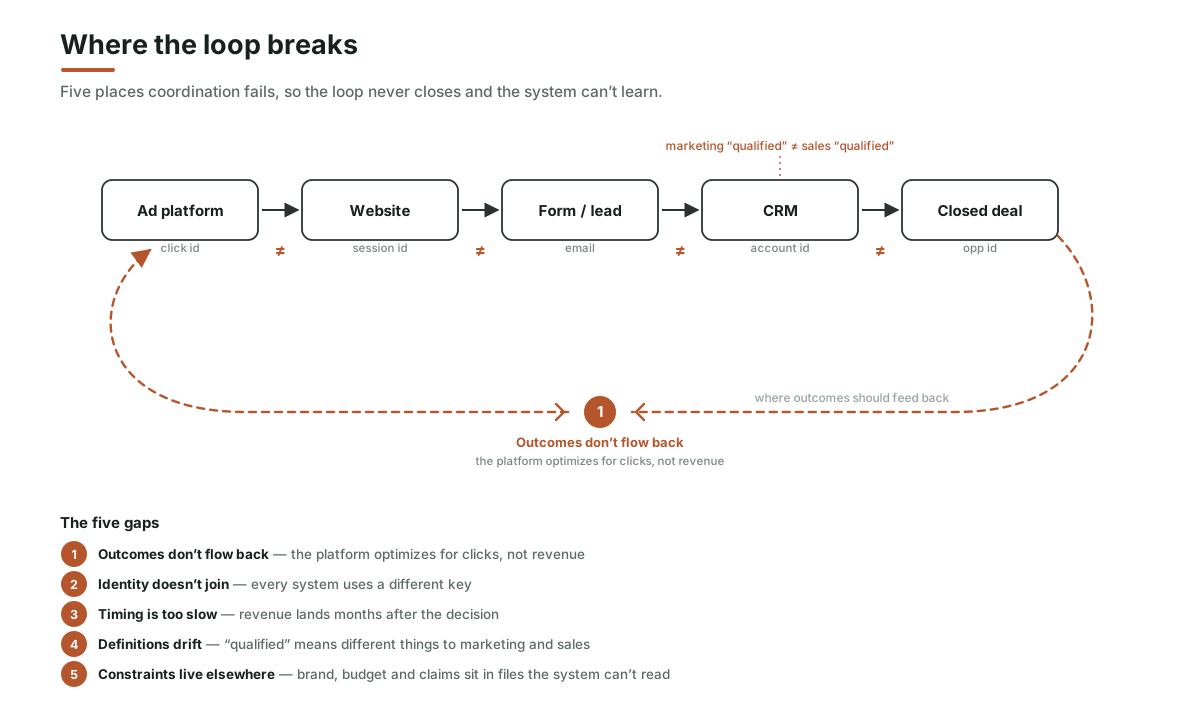
The loops break in predictable places
- Outcomes do not flow back. Your ad platform optimizes brilliantly on its own signals. But it cannot see meetings held, qualified pipeline or retention. It does not know which clicks became customers, so it optimizes for clicks.
- Identity does not join. A prospect visits your site, fills out a form, gets routed to sales, attends a demo and eventually closes. The web session, the form fill, the CRM record and the closed deal live in different systems with different identifiers. No system sees the full journey.
- Timing is too slow. In B2B, revenue outcomes arrive months after first touch. By the time you know whether a campaign worked, you have already moved on. Without faster proxy signals that reliably predict outcomes, the system cannot learn.
- Definitions drift. Marketing calls it qualified. Sales disagrees. The CRM says opportunity, but half of those are stalled. When teams do not share definitions, the data is noise dressed up as signal.
- Constraints live somewhere else. Your brand guidelines sit in a PDF. Your budget limits sit in a spreadsheet. Your approved claims sit in legal's inbox. The system cannot enforce rules it cannot see.
Each gap is solvable. But most teams underestimate how many exist at once and how much work it takes to close them. They buy new tools hoping to fix old problems and wonder why nothing improves. The answer is rarely another platform. It is coordination: connecting the systems you already own so the signals move and the loop closes. Autonomous marketing is not a stack overhaul. It is making the stack you have work as a system.
Diagnostic
Can you trace one decision end to end? What changed, why it changed, what inputs were used and what outcome it produced. If you cannot answer that for a single decision, coordination is the work. Not more AI. Better plumbing.
10
Get Started Without Getting Lost
Autonomous marketing is not one tool you buy. It is a capability you assemble inside your current stack. You do not need to rip and replace. You need to coordinate and connect. And most teams succeed by starting small: one loop, end to end, before adding complexity.
Start with one loop, not because one is all you need, but because one forces you to solve coordination before you scale. Which loop? Let the outcome guide you. If pipeline quality is the priority, start with a loop that touches qualification signals. If contribution margin matters most, start where you can measure profitability. If compliance risk keeps you up at night, start with a loop that builds audit confidence. In B2B, that often means paid search to demo requests, measured by meeting-held rate. In B2C, creative iteration in one channel with a profit-aware metric. In regulated industries, rotation among pre-approved variants with strict logging.
Before you build, start with the workflow
Sketch the signal path on a whiteboard: which systems the loop touches, what identifiers join them, what outcomes need to flow back. Map one motion end to end, ad click to landing page to form to CRM to meeting, and mark where data goes stale, gets rekeyed or cannot be joined. If you cannot draw it, the loop will not close.
Then begin with low-risk actions: rotating approved creative, adjusting send time, tuning frequency. Keep governance simple — a 30-minute weekly review of what changed, why, what moved and what needs tightening. When the loop is stable, expand one dimension at a time. One channel. One segment. One deeper outcome signal.
Be honest about the investment
Tool costs vary, but the bigger spend is integration, tracking and governance. A realistic pilot has three parts: tooling, often $2,000 to $5,000 a month for a mid-market team; integration work, roughly 40 to 80 hours of technical effort to close one loop; and ongoing governance, four to eight hours a week of monitoring and tuning. Teams that buy tools without closing the loop first tend to spend two to three times more fixing it later. Budget for one complete loop before you widen the scope.
Expect results that match the feedback loop
The payoff timing tracks the feedback loop. B2C loops with fast conversions can improve in days or weeks. B2B loops tied to pipeline quality usually take four to 12 weeks to produce trustworthy directional results, depending on volume. Small teams often benefit most here, precisely because they have the least bandwidth for constant manual optimization, so a single bounded loop delivers outsized leverage.
None of this is about removing marketers. It moves the work from button-pushing to judgment: defining goals and constraints, reading results critically, spotting when the system is optimizing the wrong thing and knowing when to override. Data literacy matters more than deep AI expertise. The most valuable skill is designing safe loops and asking the right questions. That is exactly how the best pilots reach production instead of stalling in review.
Autonomy compounds. So do mistakes. The teams that win start boring. But they stop living the same marketing day over and over again.
FAQ
Frequently Asked Questions
What is autonomous marketing?+
Autonomous marketing is the use of AI systems to make decisions and take actions across the marketing funnel, including targeting, budgeting, creative iteration, personalization and sequencing, based on goals and feedback loops. Humans define the outcomes, set the constraints and govern the boundaries. The system handles execution and optimization within those bounds.
How does autonomous marketing differ from marketing automation?+
Marketing automation is deterministic by design — you define triggers and actions and the platform executes them. Autonomous marketing treats strategy and execution as something the system can continuously improve, using performance data and constraints to decide what to test, what to prioritize and when to act. If automation is about repeatability, autonomous marketing is about adaptability.
What is bounded autonomy in marketing?+
Bounded autonomy means the AI is allowed to act inside clear guardrails and escalates anything risky to a human. This shifts operators toward human-on-the-loop governance, where you tune, monitor and handle exceptions over time instead of approving every action.
Does autonomous marketing require replacing your tech stack?+
No. Autonomous marketing is not rip and replace. It is coordinate and connect. Most organizations already have the platforms they need — ad tools, CRM, email, analytics. The gap is rarely capability. It is coordination. Autonomy emerges when those systems can share signals and act on shared outcomes.
How does autonomous marketing work in B2B?+
A B2B autonomous marketing system should optimize for pipeline quality, stage progression, win rate and account-level engagement — not MQL volume or cost per lead. The three highest-value applications are message-market fit testing, account-aware orchestration and lead-quality control. Because enterprise sales cycles run six to 12 months, B2B autonomy relies on proxy signals like meeting-held rate and early qualification outcomes to learn faster.
How does autonomous marketing work in B2C?+
B2C is the natural home for autonomy because the data is richer, the loops are faster and you can see conversion signals within hours. The three most valuable applications are creative iteration at scale, lifecycle personalization and cross-channel budget allocation. Mature teams optimize for contribution margin, payback window and cohort lifetime value — not just ROAS.
Can autonomous marketing work in regulated industries?+
Yes. The right question is not whether you can do autonomous marketing in regulated industries — you can. The question is where autonomy can live safely and how you prove it behaved correctly. A risk-tiered workflow pattern works well: low-risk changes auto-ship, medium-risk changes require approval, high-risk changes are blocked or routed through formal review. Every action logs the input signals, the constraint set, the chosen action and the measured outcome.
Why do most autonomous marketing implementations fail?+
Autonomous marketing pilots do not fail because the AI is not smart enough. They fail because the loops cannot close. The five predictable failure points are: outcomes do not flow back to ad platforms; identity does not join across web, CRM and sales systems; timing is too slow for B2B revenue signals; definitions drift between marketing and sales; and constraints like brand guidelines and budget limits live outside the system.
How do you get started with autonomous marketing?+
Start with one loop end to end before adding complexity. Sketch the signal path on a whiteboard: which systems the loop touches, what identifiers join them, what outcomes need to flow back. Begin with low-risk actions — rotating approved creative, adjusting send time, tuning frequency. Keep governance simple with a 30-minute weekly review. When the loop is stable, expand one dimension at a time: one channel, one segment, one deeper outcome signal.
See Where Your Loops Break
Most teams cannot name the first loop to close, because they cannot see where coordination fails. That is the fastest thing to diagnose.